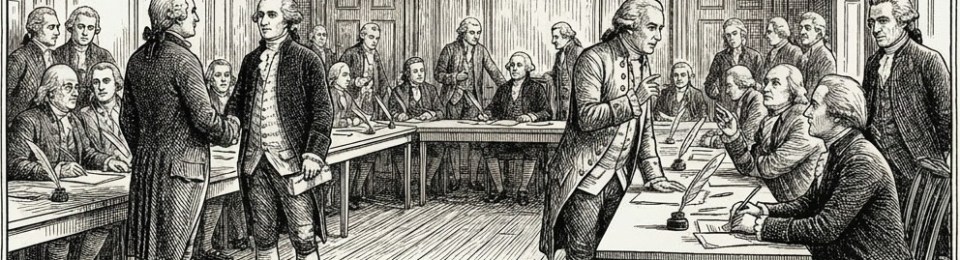
Completed in May 2026, The Framers of the Constitution: Princeton, 1783 project is a historically grounded visual reconstruction created in anticipation of the 250th anniversary of the formation of the United States. It combines archival research, forensic architectural analysis, and a deep understanding of time, place, and material culture to recreate Princeton as it existed when it briefly served as the nation’s capital in 1783.Core Summary
The project reconstructs Princeton in 1783, the moment when the Confederation Congress met in Nassau Hall, drawing figures such as George Washington, James Madison, Alexander Hamilton, and Thomas Jefferson to the town. This period is well‑documented in letters and accounts from the era, including those of Charles Thomson, Secretary of Congress, whose correspondence vividly describes Princeton’s conditions and daily life during its short tenure as the capital.
Forensic Architectural & Spatial Analysis
The project reconstructs thirteen key buildings and the surrounding townscape using:
- Surviving 18th‑century architectural drawings
- Period engravings and portraits
- Property records and early Princeton maps
- Comparative analysis of similar structures from the era
This approach mirrors forensic archaeology—piecing together incomplete evidence to recreate a historically accurate built environment.
The result is a precise architectural rendering of Princeton as Congress would have experienced it.
Understanding Time, Place & Cultural Context
The project situates Princeton within:
- The post‑Revolutionary landscape, still marked by battle damage and recovery
- The social world of 1783, including the presence of prominent delegates and local figures like Annis Stockton, whose letters reflect the town’s excitement and challenges during Congress’s stay.
- The intellectual environment shaped by the College of New Jersey (Princeton), which educated nine Framers and influenced early American political thought.
 Welcome to Anderson-Eye Studios